
How to Choose a Home Water Purifier in UAE
A purifier that looks right under the sink can still be the wrong choice if it cannot keep up with your household, does not suit your building’s water supply, or is difficult to service. When you choose home water purifier equipment, the goal is not simply lower TDS on a display. It is dependable, better-tasting drinking water every day, with a system that fits your home and can be maintained properly.
For homes in Dubai and across the UAE, that decision often starts with reverse osmosis. But membrane capacity, pre-filters, installation quality, pressure, and after-sales support all affect the result. Here is how to make a practical choice.
Start with your water source and actual concern
Do not choose a system based only on a neighbor’s recommendation or an online product photo. First consider where your water comes from and what you want to improve. In many UAE homes, water is supplied through a building or villa tank. The water may be suitable for its intended supply purpose, yet taste, odor, sediment, chlorine, and dissolved solids can vary depending on the source, storage tank condition, pipes, and maintenance.
A basic water assessment can help identify the right treatment path. TDS is useful because it indicates the amount of dissolved material in water, but it is not a complete measure of water quality. High TDS does not identify every substance present, and low TDS alone does not confirm that water is free from all concerns. A good recommendation looks at your source water, household needs, and the filters required before the RO membrane.
If your main concern is drinking and cooking water, an under-sink reverse osmosis system is usually the most focused option. If you are also dealing with sand, rust, visible particles, scale, or water quality issues throughout the property, you may need whole-house sediment filtration or a water softener in addition to a drinking-water purifier.
Choose a home water purifier by daily demand
Capacity is one of the most overlooked buying factors. Reverse osmosis systems are commonly rated in GPD, meaning gallons per day. This rating helps indicate how much purified water the unit can produce under suitable operating conditions. It is not just a larger-number-is-better decision.
A compact 400 GPD system can be a strong fit for many apartments and smaller families using purified water for drinking, tea, coffee, ice, and cooking. A larger family, frequent guests, a home with staff, or anyone who fills several bottles each day may benefit from an 800 GPD system. Larger capacities such as 1,500 GPD and above are generally more suitable for villas with high demand, offices, cafés, or commercial applications.
Think about peak use, not only average use. A family may consume modest amounts during the day but need several liters quickly in the morning, after school, or while preparing meals. A system with insufficient capacity can leave you waiting for the tank or outlet flow to recover. One that is far oversized may cost more than necessary and use valuable cabinet space.
Ask where the purified water will be used
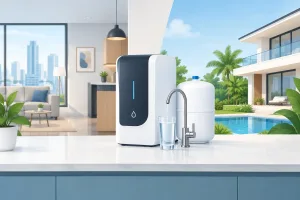
An under-sink unit can serve a dedicated drinking-water faucet and, where suitable, a refrigerator water line. This keeps purified water available where it matters most. For a larger property, a separate point-of-use system in the kitchen may still be more practical than trying to use RO water for every shower, laundry load, and cleaning task.
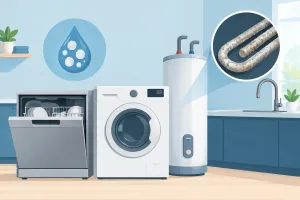
Whole-house systems have a different role. Sediment filters help protect plumbing and appliances from particles, while water softeners can help manage hardness-related scale. They are often paired with, rather than substituted for, an RO drinking-water system.
Look beyond the RO membrane
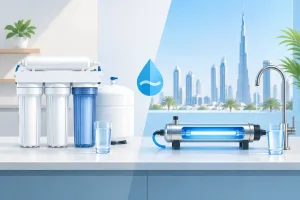
The membrane is central to an RO system, but it cannot do its job well without the right filtration stages around it. Pre-filters commonly reduce sediment and chlorine or improve taste and odor before water reaches the membrane. This helps protect the membrane and supports more consistent performance.
Post-filtration can improve the taste of drinking water after purification. Some homes may also benefit from additional stages based on their water assessment and preferences. The best configuration depends on the incoming water and your goals, not on choosing the longest list of filter stages.
Be cautious with vague claims such as “removes everything.” No responsible system selection should rely on broad promises without considering the unit’s design, consumables, operating conditions, and maintenance schedule. Ask what each filter does, how often it needs replacement, and whether replacement parts will be readily available.
Make sure the system suits the installation space
Before purchasing, look under the kitchen sink. Measure the available width, depth, and height, and consider the drain connection, water inlet, electrical point if required, and access for future filter changes. A high-capacity system may need more room than a compact model.
Professional installation matters because even a quality purifier can cause frustration if tubing is poorly routed, fittings are not secured, or the drain connection is incorrect. The installer should check water pressure, inspect the available space, test the system after installation, and explain how to use it.
For apartment residents, building access and sink cabinet layout can affect the installation plan. Villa owners may have more room for equipment but may also need to consider tank-fed supply, outdoor conditions, and whole-house pre-treatment. This is why a site assessment is often more useful than selecting a unit from capacity alone.
Plan for filter replacement from day one
A purifier is not a fit-and-forget appliance. Filters collect sediment and reduce chlorine or other unwanted compounds over time. The RO membrane also has a service life that depends on incoming water quality, water usage, pre-filter condition, and maintenance.
Replacement timing varies, so avoid treating any single interval as universal. In many homes, pre-filters need attention more often than the membrane. If filter changes are delayed, water flow can drop, purification performance can suffer, and the membrane may wear out earlier than expected.
Choose a provider that can clearly explain the maintenance schedule and supply genuine, compatible replacement filters. Annual maintenance plans can be especially useful for busy households, landlords, and facilities managers who do not want to track service dates themselves. Reliable support is part of the value of the system, not an optional extra after the sale.
Compare ownership value, not just purchase price
The least expensive purifier may become costly if installation is excluded, filters are hard to find, or service is slow when a leak or low-flow issue occurs. Compare what is included in the full ownership experience: delivery, installation, warranty, initial service coverage, replacement filters, technician availability, and ongoing maintenance options.
A clear warranty offers reassurance, but ask what it covers and how service requests are handled. For homes in the UAE, a supplier familiar with local water conditions can make a meaningful difference in selecting pre-filtration, setting up the system correctly, and responding when maintenance is due.
Aqua Care supports this approach with systems designed for local conditions, professional installation, and continuing service rather than treating purification as a one-time appliance purchase.
Questions to ask before you decide
Before approving an installation, get direct answers to a few practical questions. What capacity is recommended for my family or property, and why? Which filters are included? How often are they usually replaced? Is the system appropriate for my incoming water and pressure? What is included with installation and warranty coverage? Who will handle maintenance after the first service period?
The answers should be simple and specific. If a provider cannot explain the system in plain language, it will be harder to manage later.
The right purifier should quietly become part of your routine: clean water at the kitchen sink, no last-minute bottle runs, and a service team to call when filters are due. Choose for that long-term convenience, not just for the unit sitting in the cabinet.

About author