UAE Drinking Water Guide for Homes and Offices
A glass of water can look perfectly clear and still leave you wondering what it picked up before it reached your kitchen tap. That is why a practical UAE drinking water guide needs to look beyond the water source. In many homes and offices, the final water quality is shaped by desalination, building storage tanks, plumbing condition, water pressure, and the filtration system under the sink.
For UAE residents, the goal is not to be alarmed by every reading or taste change. It is to understand what affects drinking water in your property, choose treatment that fits your needs, and keep it maintained. A good system should make safe, pleasant drinking water easy to access every day.
UAE Drinking Water Guide: Start With Your Water Journey
Much of the UAE’s municipal water supply comes from desalination. It is treated before distribution, but the water does not travel directly from a treatment plant into your glass. In apartments, villas, offices, and commercial buildings, it may pass through storage tanks and internal pipework first.
This is why two properties in the same neighborhood can have different water concerns. One household may notice a salty or mineral-like taste. Another may have sediment from an aging tank or pipework. A villa with hard water may see scale around faucets and appliances, while an apartment resident may mainly want better-tasting water for cooking and drinking.
Water quality is also not static. Tank cleaning schedules, renovations, seasonal demand, changes in plumbing, and filter condition can all affect what comes from the tap. Rather than choosing a purifier based on a neighbor’s recommendation alone, consider your household size, water usage, existing water pressure, and the condition of the property.
Is UAE Tap Water Safe to Drink?
The answer depends on what you mean by safe and where the water is drawn. Treated municipal water is subject to standards, but many residents prefer additional filtration because water can be affected after it enters a building. Storage tanks, distribution lines, and fixtures are the practical concerns inside a property.
For drinking and cooking, an appropriately selected and maintained point-of-use system gives households more control over taste, dissolved solids, and common contaminants. It also reduces reliance on carrying bottled water home or arranging frequent deliveries.
A water purifier is not a substitute for basic building maintenance. If water has a strong odor, unusual color, visible particles, or a sudden change in taste, inspect the tank and plumbing condition as well as the filter. A new machine cannot solve every upstream problem on its own.
Understanding TDS Without Overthinking It
TDS means total dissolved solids. It measures the combined amount of dissolved minerals, salts, and other substances in water. In the UAE, TDS is commonly discussed because desalinated water, blended water, pipework, and storage conditions can produce different readings at different locations.
A high TDS reading does not identify exactly what is in the water or automatically prove that it is unsafe. Likewise, a low reading alone does not guarantee water quality. TDS is useful as one indicator, especially for checking reverse osmosis performance over time, but it should be considered alongside taste, odor, filter condition, and, where needed, professional water testing.
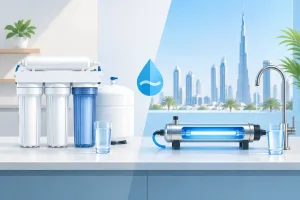
Reverse osmosis, often called RO, is a popular choice for drinking water because it is designed to reduce dissolved salts and many unwanted impurities. A good RO system normally uses several stages, including sediment and carbon filtration before the RO membrane. The sediment stage helps protect the system from particles, while carbon filtration improves taste and helps address chlorine-related concerns.
The right target is not simply the lowest possible number on a meter. It is consistently clean, pleasant-tasting drinking water produced by a correctly installed system and supported by timely service.
Which Water Filter Fits Your Property?
The right setup depends on what you want to improve. There is no single unit that is best for every home, villa, restaurant, or workplace.
Under-Sink RO Systems for Drinking Water
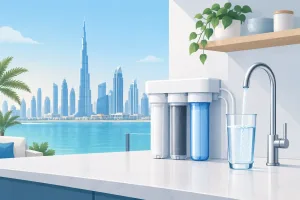
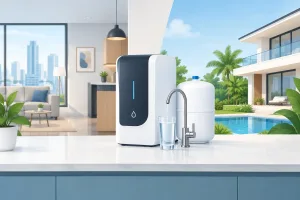
For most apartments and family homes, an under-sink RO system is the practical starting point. It treats water at the kitchen sink, where you fill glasses, bottles, kettles, and cooking pots. Compact systems can suit a smaller household, while higher-output models are useful for larger families or homes with heavier daily demand.
Capacity is often stated in GPD, or gallons per day. A 400 GPD system can be suitable for many standard household needs, while 800 GPD and higher capacities can support larger households, staff kitchens, and locations that need faster water production. Capacity alone should not decide the purchase. Installation space, incoming water pressure, wastewater management, and the number of users also matter.
Whole-House Filtration for Water Throughout the Property
A whole-house filter is installed at the main water entry point. It is intended to improve water quality before water reaches showers, bathrooms, washing machines, water heaters, and kitchen fixtures. Sediment filtration can help reduce particles, while other media may be selected for specific water conditions.
Whole-house filtration and RO serve different purposes. A whole-house system can improve the water used around the property, but it does not necessarily replace a dedicated RO purifier for drinking water. In many villas, the most effective approach is both: whole-house pre-filtration for general protection and RO at the kitchen for drinking and cooking.
Water Softeners for Hard-Water Problems
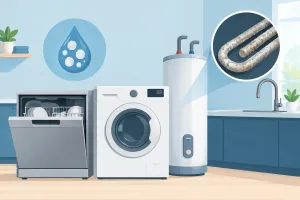
If you regularly see white scale on faucets, shower glass, kettles, and heating equipment, hard water may be the issue. A water softener can reduce the minerals that cause scale, helping protect fixtures and appliances while making cleaning easier.
A softener is not the same as a drinking water purifier. It is usually chosen to manage hardness throughout the property. For drinking water, it can be paired with a properly designed RO system at the kitchen sink.
Shower Filters for a Focused Upgrade
A shower filter is a smaller, localized option for residents who want to improve shower water without installing a full-property system. It can be useful for renters or households that need a simple solution, but it has a different role from whole-house filtration and cannot address all water-quality concerns throughout the home.
Installation Matters More Than Many Buyers Expect
Even a high-quality purifier can underperform when installation is rushed or poorly planned. The technician should assess available space, water inlet access, drainage, pressure, and the route for tubing before fitting the unit. Connections need to be secure, the system should be flushed correctly, and the customer should know how to use the faucet and monitor basic performance.
For commercial sites, the planning stage becomes even more important. A staff pantry, café, clinic, school, or facility may require a high-capacity RO system based on real peak demand rather than an estimate. The system should be sized for usage patterns, storage needs, and service access. Choosing too small a unit can mean slow output and frustrated users. Choosing an oversized unit without considering demand and maintenance can add unnecessary cost.
Professional installation also gives you one accountable provider for delivery, fitting, filter replacement, repairs, and maintenance. Aqua Care provides systems designed for UAE water conditions, along with professional installation, a one-year warranty, and ongoing service options for households and businesses.
Filter Changes Are Part of the System, Not an Extra
A purifier is only as reliable as its maintenance. Pre-filters gradually collect sediment and carbon filters become less effective over time. RO membranes also need monitoring, particularly when incoming water quality is demanding or daily usage is high.
Replacement timing depends on the system, filter type, water condition, and consumption. A busy family or office may need service sooner than a lightly used apartment kitchen. Waiting until water tastes unpleasant is not a dependable maintenance plan, because filter performance can decline before an obvious taste change appears.
Watch for slower water flow, a different taste or smell, leaks, unusual pump noise, or a noticeable rise in TDS after the RO system. These signs do not always mean the same thing, but they are good reasons to arrange an inspection. Keeping a service record helps prevent missed replacements and makes it easier to identify recurring issues.
Bottled Water or a Home Purifier?
Bottled water is convenient in some situations, especially for travel, temporary accommodation, or emergency storage. For daily household use, however, it can create recurring delivery costs, plastic waste, and the inconvenience of storing heavy bottles.
An RO system can provide filtered drinking water at the point of use, but it requires an upfront investment and regular servicing. For many UAE households, that trade-off is worthwhile when the system is installed correctly and maintained by trained technicians. The best choice comes down to usage, budget, storage space, and whether you value a consistent supply from your own kitchen tap.
A reliable drinking water setup should feel simple after installation: clean water when you need it, clear guidance on service, and support when something changes. Start with the conditions in your own property, then choose equipment and maintenance that will continue to work long after the first glass is poured.

About author