RO Versus UV Purification for UAE Households
A glass of water can look perfectly clear and still leave an open question: what is actually dissolved in it, and has it been properly treated? That is why RO versus UV purification is not simply a comparison of two appliances. For homes, villas, offices, and food-service sites, the right choice depends on the incoming water, the concern you need to address, and how consistently the system will be maintained.
In the UAE, many properties receive desalinated municipal water, while others may have water stored in tanks or supplied through building plumbing with different conditions. A system should be selected for the water at your tap, not based on a one-size-fits-all promise.
What Reverse Osmosis Does
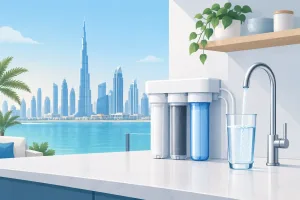
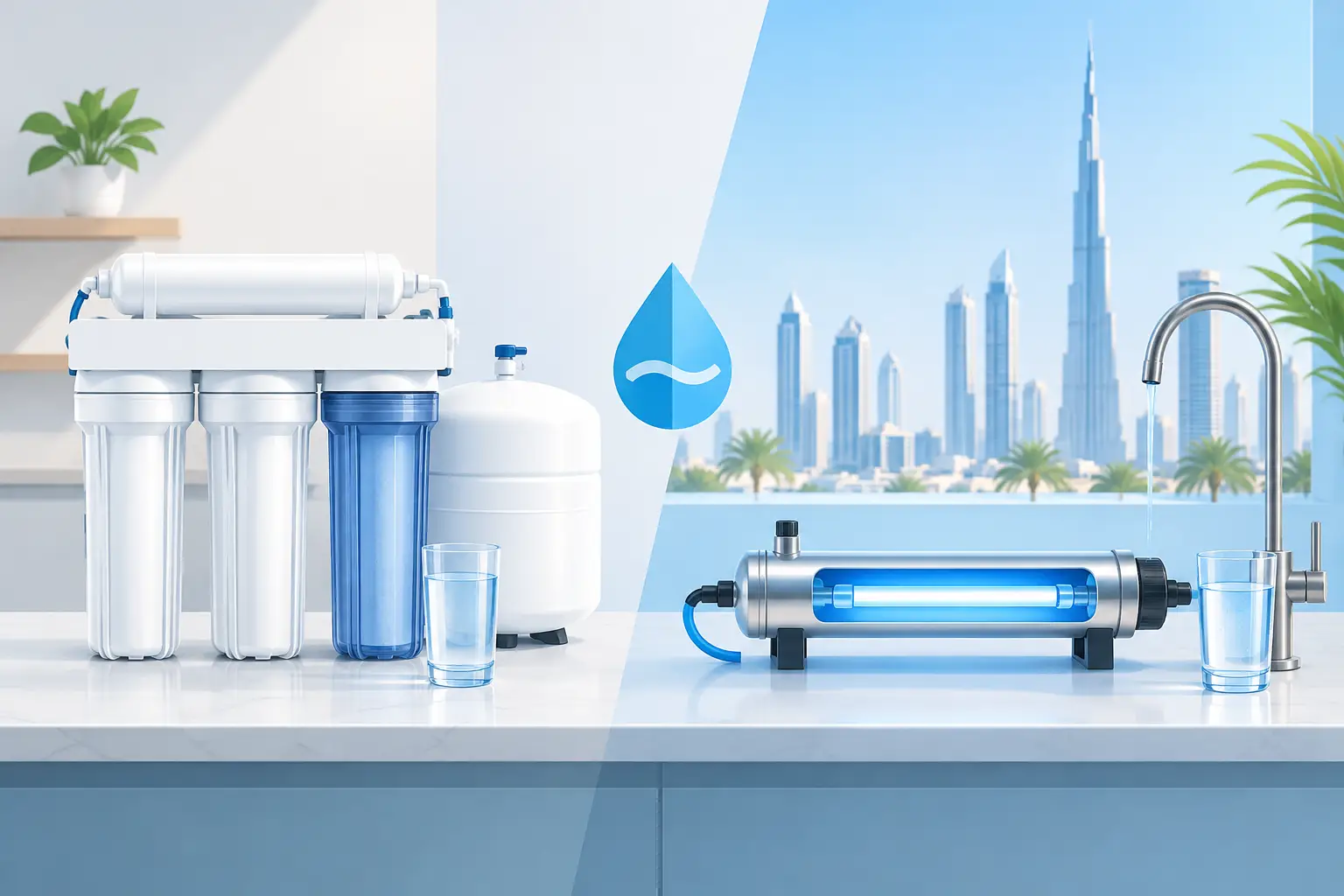
Reverse osmosis, usually called RO, forces water through a very fine membrane. That membrane is designed to reduce a wide range of dissolved substances, including salts, minerals, and many impurities that raise total dissolved solids, or TDS. An RO system also normally includes pre-filters to catch sediment and reduce chlorine before water reaches the membrane, followed by a post-filter for better taste.
This makes RO a strong option when the goal is cleaner-tasting drinking water with lower TDS. It is particularly relevant for households that notice a salty taste, scale buildup, or inconsistent quality from their source water. It is also a practical choice for people who want dedicated purified water at the kitchen sink for drinking, cooking, tea, coffee, and infant formula preparation.
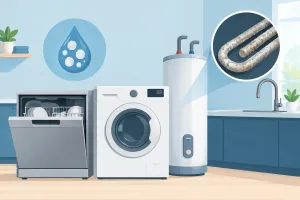
An RO unit is not a whole-house replacement in every situation. It is most often installed as a point-of-use drinking water system. If hard water is damaging fixtures or leaving scale across the property, a water softener or whole-house filtration system may be needed alongside it.
What UV Purification Does
UV purification uses ultraviolet light to disinfect water. As water passes through the UV chamber, the light damages the genetic material of microorganisms, preventing bacteria, viruses, and other microbes from reproducing. It does not add chemicals or change the taste of water.
UV can be valuable where microbial control is the central concern, such as properties using well water, stored water with uncertain hygiene, or water sources that may be exposed to contamination after treatment. It works quickly, but it has a clear limitation: UV does not remove dissolved salts, heavy metals, sediment, chlorine, or TDS. Water can pass through a UV system and still have the same mineral content and taste as before.
UV also needs clear water to work properly. Sediment, cloudiness, or color can shield microorganisms from the light. For that reason, a UV unit should be paired with suitable pre-filtration and kept clean according to its service schedule.
RO Versus UV Purification: The Key Difference
The simplest way to understand RO versus UV purification is this: RO removes many dissolved impurities, while UV disinfects microorganisms. One filters through a membrane; the other treats with light. Neither technology automatically does the other job.
If the concern is high TDS, salty taste, dissolved contaminants, or the desire for premium drinking water at a kitchen tap, RO is generally the more suitable starting point. If a water test or site assessment identifies microbial risk, UV may be recommended as an additional barrier.
Many effective purification setups use both technologies. Pre-filters remove particles, RO reduces dissolved impurities, and a UV stage provides an added level of microbial protection. Whether that combination is necessary depends on the source water and the property’s needs. Adding equipment without understanding the water issue can increase cost and maintenance without providing meaningful benefit.
Which System Fits Your Property?
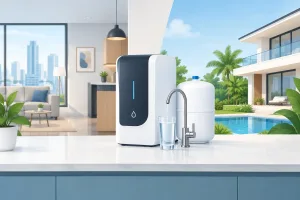
For most apartments connected to treated municipal water, an under-sink RO system is often the practical choice for drinking water. It provides a dedicated source of purified water without changing the plumbing for the entire apartment. Capacity matters here. A smaller household may be well served by a compact system, while a large family, busy kitchen, or office pantry may benefit from a higher-GPD unit that refills more quickly.
Villas and larger properties require a broader look. If the concern is only drinking water in the kitchen, an RO system can still be the right answer. If there is sediment from storage tanks, scale on showers and appliances, or changes in water quality throughout the property, consider a treatment plan that combines sediment filtration, softening, and point-of-use RO where it matters most.
For restaurants, offices, clinics, and facilities, demand and reliability are just as important as water quality. High-output RO systems can support greater daily volume, but the correct GPD rating should be based on actual use patterns, peak demand, storage capacity, and available installation space. A system that is too small can cause delays and strain components. One that is oversized may add unnecessary cost.
Water Waste, Pressure, and Running Costs
RO systems produce purified water and a separate reject-water stream that carries away concentrated dissolved solids. The exact amount depends on the unit, feed-water quality, pressure, and system design. This is a real trade-off to consider, especially where water conservation is a priority.
A professional installation can help the system run efficiently by confirming suitable water pressure, drainage, and filter configuration. Some households also choose to collect suitable reject water for non-drinking uses, where safe and permitted, rather than sending all of it directly to drain.
UV systems do not create reject water, but they use electricity to power the lamp. Their running cost is usually modest, although the lamp must be replaced at the recommended interval even if it still appears to be glowing. A visible lamp is not always a fully effective lamp.
Maintenance Is Part of Purification
The best system is only effective when its filters, membrane, or lamp are serviced on time. Pre-filters in an RO unit protect the membrane and should be changed based on water quality and usage. The RO membrane lasts longer, but it also has a service life and should be checked when purified-water flow falls or TDS reduction declines.
UV systems require regular cleaning of the quartz sleeve and replacement of the UV lamp. If sediment is allowed to build up in front of the chamber, UV performance can drop even when the unit is switched on.
This is where choosing a provider with installation and after-sales support makes a practical difference. Proper filter selection, scheduled replacements, TDS checks, and responsive repairs protect both your water quality and the life of the equipment. Aqua Care helps customers match purification capacity and service needs to local water conditions rather than leaving them to guess which parts to replace and when.
Start With the Water You Have
Do not choose between RO and UV based only on a product label or a neighbor’s recommendation. Start with the source, the condition of your plumbing and storage tanks, your water usage, and the result you want at the tap. A water-quality assessment can identify whether dissolved solids, sediment, hardness, microbial protection, or a combination of these concerns needs attention.
For many UAE households, RO is the main solution for better-tasting, lower-TDS drinking water. UV becomes valuable when microbial disinfection is needed as well. The most reassuring choice is a correctly sized system, professionally installed, with a maintenance plan that keeps doing its job long after installation day.

About author